What Causes a Person to Pass Away in Her Sleep
| Sudden arrhythmic death syndrome | |
|---|---|
| Other names | Sudden adult death syndrome (SADS), bed death, sudden unexpected/unexplained death syndrome (SUDS), sudden unexpected/unexplained nocturnal expiry syndrome (SUNDS), Sudden Death Syndrome |
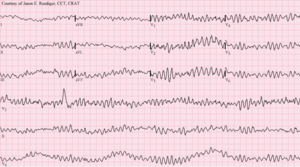 | |
| A type of a deadly ventricular arrhythmia - Ventricular fibrillation pattern seen on an EKG | |
| Specialty | Cardiology  |
| Causes |
|
| Frequency | 14.9 per 100,000 people in Nippon 110.8 per 100,000 people in Us[1] |
Sudden arrhythmic expiry syndrome (SADS) is a sudden unexpected death of adolescents and adults, mainly during sleep.[2] 1 relatively common type is known equally Brugada syndrome.[iii] [4]
The syndrome is rare in most areas around the world but occurs in populations that are culturally and genetically singled-out. It was first noted in 1977 among southeast Asian Hmong refugees in the United States and Canada.[5] [6] The syndrome was once again noted in Singapore when a retrospective survey of records showed that 230 otherwise salubrious Thai foreign workers living in Singapore died suddenly of unexplained causes between 1982 and 1990.[7]
Causes [edit]
A sudden death in a immature person can be caused past eye disease (including cardiomyopathy, congenital heart disease, myocarditis, genetic connective tissue disorders) or conduction disease (WPW syndrome, etc), medication-related causes or other causes.[8] Rare diseases called ion channelopathies may play a role such every bit long QT syndrome (LQTS), Brugada syndrome (BrS), CPVT (catecholaminergic polymorphic ventricular tachycardia), PCCD (progressive cardiac conduction defect), early repolarization syndrome, mixed sodium channel disease, and short QT syndrome.[8] In 20% of cases, no crusade of death can be plant, even afterwards extensive examination.[eight]
Medical examiners have taken into account various factors, such as nutrition, toxicology, heart affliction, metabolism, and genetics. Although in that location is no existent known definite cause, all-encompassing research showed people xviii years or older were found to accept suffered from a hypertrophic cardiomyopathy, a status in which the heart muscle becomes oddly thickened without any obvious crusade.[9] This was the nearly commonly identified aberration in sudden death of young adults. In the instances where people experience sudden death, it is well-nigh commonly found that they were suffering from CAD (coronary artery illness) or ASCAD (atherosclerotic coronary artery illness), or whatever level of stress.[ix] Notwithstanding, studies reveal that people experienced early symptoms within the week earlier the terminal consequence such as chest pain at ~52% of victims, dyspnea at ~22%, syncope at ~vii% and ~19% who experienced no symptoms.[9] Scientists have also associated this syndrome with the factor SCN5A that is mutated and affects the role of the heart. All the same, all autopsies done on victims who suffered from this syndrome came back negative.[nine]
In Thailand, Laos, and the Philippines, bangungot (or in their term, sudden adult death syndrome) is mainly caused by the Brugada syndrome.[10]
Diagnosis [edit]
Diagnosis occurs mail-mortem.
Treatment [edit]
The merely proven fashion to prevent SADS is with an implantable cardioverter-defibrillator. Oral antiarrhythmics such as propranolol are ineffective.[11]
Epidemiology [edit]
In 1980, a reported pattern of sudden deaths was brought to the attention of the Centers for Disease Control. The first reported sudden death occurred in 1948 when at that place were 81 like deaths of Filipino men in Oahu Canton, Hawaii. All the same, it did not get relevant because there was no associated pattern. This syndrome continued to become more meaning as years went on. By 1981–1982, the annual rate in the U.s.a. was high with 92/100,000 amongst Laotians-Hmong, 82/100,000 amidst other Laotian ethnic groups, and 59/100,000 among Cambodians.[12]
In a 2008 report information technology was constitute that over half of SADS deaths could be attributed to inherited heart illness: unexplained premature sudden deaths in family unit, long QT syndrome, Brugada syndrome, arrhythmogenic right ventricular cardiomyopathy and others.[13]
Asia [edit]
Southeast Asian immigrants, who were by and large fleeing the Vietnam War, almost oft had this syndrome, marking Southeast Asia equally the area containing the most people with this fatal syndrome. However, at that place are other Asian populations that were affected, such equally Filipinos and Chinese immigrants in the Philippines, Japanese in Japan, and natives of Guam in the United states of america and Guam.[12] Withal, these item immigrants who had this syndrome were virtually 33 years former and seemingly salubrious and all only one of the Laotian Hmong refugees were men.[14] The condition appears to impact primarily young Hmong men from Laos (median age 33)[fifteen] and northeastern Thailand (where the population are mainly of Laotian descent).[sixteen] [17]
History [edit]

Map of Thailand highlighting Loei Province
Laotian Hmongs were called for the study because they had one of the highest sudden decease rates while sleeping in the U.s.a.. They were originally from Southern Prc and the highlands of North Vietnam, Laos, and Thailand. The location that was picked for this study was in Ban Vinai in the Loei Province, which is approximately 15 kilometers from the Lao edge. This study took place between October 1982 and June 1983 every bit this syndrome became more of a relevant pressing effect. Ban Vinai was the location chosen because it had 33,000 refugees in 1982, which was the largest population of victims.[12] Because this syndrome was occurring nearly commonly in those particular men, researchers found it well-nigh benign and effective to study the population in which they migrated from instead of studying victims and populations in the U.S. Because of religious limitations the Hmong men in Ban Vinai were non allowed to receive autopsies. Therefore, the but results and enquiry obtained were victims outside of their religion or geographical area. An interview was arranged with the next of kin who lived with the victim, witnessed the expiry, or plant the body. The interviews were open ended and allowed the person who was next of kin to describe what they witnessed and what preceding events they thought were relevant to the victim's death. The interviewers also collected information such equally disease history, the circumstances of the death, demographic groundwork, and history of any sleep disturbances. A genealogy was and then created which included all the relatives and their vital status and circumstances of expiry.[12]
Society and culture [edit]
During the 1970s and 1980s, when an outbreak of this syndrome began, many of the Southeast Asians were not able to worship properly due to the guerrilla war against the government of Laos with the U.s.a.. Hmong people believe that when they exercise non worship properly, practise not perform religious ritual properly or forget to sacrifice, the antecedent spirits or the village spirits do not protect them, thus assuasive the evil spirit to reach them. These attacks induce a nightmare that leads to sleep paralysis when the victim is conscious and experiencing pressure level on the breast.[fourteen] It is also common to have a REM state that is out of sequence where there is a mix of encephalon states that are normally held separate.[14] Afterwards the war, the United states government scattered the Hmong across the country to 53 different cities.[14] In one case these nightmare visitations began, a shaman was recommended for psychic protection from the spirits of their sleep.[xiv] However, scattered beyond 53 unlike cities, these victims had no admission to any or the correct shaman to protect them from this syndrome.
Hmong people believed that rejecting the role of becoming a shaman, they are taken into the spirit world.
In a medical journal, the author suggested that the Hmong who died were killed by their ain beliefs in the spiritual world, otherwise known as Nocturnal pressing spirit attacks. In Republic of indonesia it is called digeuton, which translates to "pressed on" in English.[fourteen] In China it is chosen bèi guǐ yā (traditional Chinese: 被鬼壓; simplified Chinese: 被鬼压) which translates to "crushed by a ghost" in English language.[fourteen] The Dutch phone call the presence a nachtmerrie, the night-mare.[xiv] The "merrie" comes from the Middle Dutch mare, an incubus who "lies on people's chests, suffocating them". This phenomenon is known among the Hmong people of Laos,[18] who ascribe these deaths to a malign spirit, dab tsuam (pronounced "dah chua"), said to take the form of a jealous woman.
Bangungot is depicted in the Philippines every bit a mythological creature called batibat or bangungot.[xix] This hag-like creature sits on the victim's face or breast then as to immobilize and suffocate him. When this occurs, the victim usually experiences paralysis.
The sudden expiry of immature Hmong children was the inspiration for Wes Craven's horror film A Nightmare on Elm Street.
English names [edit]
| Name | Acronym | Notes |
|---|---|---|
| sudden unexpected death syndrome | SUDS | |
| sudden unexplained death syndrome | SUDS | |
| sudden unexpected nocturnal decease syndrome | SUNDS | |
| sudden unexplained nocturnal death syndrome | SUNDS | |
| sudden adult death syndrome | SADS | (parallel in form with SIDS) |
| sudden arrhythmia expiry syndrome | SADS | |
| sudden arrhythmic expiry syndrome | SADS | |
| sudden arrhythmic cardiac decease syndrome | — | |
| bed death | — |
Names in other languages [edit]
| Term | Language | Notes |
|---|---|---|
| lai tai | Thai | Thai: ใหลตาย; meaning "slumber and die"[xvi] [20] |
| bangungot or urom | Filipino[21] | The term originated from the Tagalog word pregnant "to rising and moan in slumber".[22] It is as well the Tagalog give-and-take for nightmare. |
| dab tsog | Hmong[eighteen] | dab tsog means "ghost" |
| dolyeonsa | Korean | Korean: 돌연사; meaning literally "sudden death" |
| pokkuri illness | Japanese[23] | |
| ya thoom [ citation needed ] | Arabic | |
| albarsty (Kyrgyz: албарсты) | Kyrgyz |
Meet also [edit]
- Brugada syndrome
- Night hag
- Slumber paralysis
- Sudden babe death syndrome
- Sudden unexpected decease in epilepsy
- Sudden unexplained death in childhood
- Yunnan sudden death syndrome
References [edit]
- ^ Yuan, David; Raju, Hariharan (12 September 2019). "Spotlight on sudden arrhythmic death syndrome". Research Reports in Clinical Cardiology. 10: 57–66. doi:x.2147/RRCC.S187480.
- ^ Also known as SUDS. See: Reddy PR, Reinier K, Singh T, Mariani R, Gunson Yard, Jui J, Chugh SS. Concrete activeness as a trigger of sudden cardiac abort: The Oregon Sudden Unexpected Death Study. Int J Cardiol. 2008
- ^ "Brugada Syndrome". NORD (National Organization for Rare Disorders). 2016. Retrieved 28 October 2017.
- ^ "Brugada syndrome". Genetics Home Reference . Retrieved 28 October 2017.
- ^ Centers for Disease Control (CDC) (1981). "Sudden, unexpected, nocturnal deaths amidst Southeast Asian refugees". MMWR. Morbidity and Mortality Weekly Report. 30 (47): 581–589. PMID 6796814.
- ^ Parrish RG, Tucker M, Ing R, Encarnacion C, Eberhardt M (1987). "Sudden unexplained death syndrome in Southeast Asian refugees: a review of CDC surveillance". MMWR Surveillance Summaries. 36 (1): 43SS–53SS. PMID 3110586.
- ^ Goh KT, Chao TC, Chew CH (1990). "Sudden nocturnal deaths among Thai construction workers in Singapore". Lancet. 335 (8698): 1154. doi:10.1016/0140-6736(90)91153-2. PMID 1971883. S2CID 46669256.
- ^ a b c Elijah R Behr. "When a young person dies suddenly" (PDF). Cardiac Risk in the Young - Weep. Archived from the original (PDF) on 20 July 2014.
- ^ a b c d Eckart, Robert E.; Shry, Eric A.; Burke, Allen P.; McNear, Jennifer A.; Appel, David A.; Castillo-Rojas, Laudino M.; Avedissian, Lena; Pearse, Lisa A.; Potter, Robert N. (2011). "Sudden Death in Immature Adults". Journal of the American Higher of Cardiology. 58 (12): 1254–1261. doi:10.1016/j.jacc.2011.01.049. PMID 21903060.
- ^ Tessa R. Salazar (xix June 2004). "Bangungot' in family? Run across a heart specialist". Inquirer News Service. Archived from the original on 30 June 2004.
- ^ Nademanee Thou, Veerakul G, Mower 1000, et al. (2003). "Defibrillator Versus beta-Blockers for Unexplained Death in Thailand (DEBUT): a randomized clinical trial". Apportionment. 107 (17): 2221–6. doi:ten.1161/01.CIR.0000066319.56234.C8. PMID 12695290.
- ^ a b c d Munger, Ronald (September 1987). "Sudden Death in Slumber of Laotian-Hmong Refugees in Thailand: A Instance-Control Written report". American Periodical of Public Health. 77 (ix): 1187–90. doi:x.2105/ajph.77.9.1187. PMC1647019. PMID 3618851.
- ^ Behr, Elijah R.; Dalageorgou, Chrysoula; Christiansen, Michael; Syrris, Petros; Hughes, Sian; Tome Esteban, Maria T.; Rowland, Edward; Jeffery, Steve; McKenna, William J. (July 2008). "Sudden arrhythmic death syndrome: familial evaluation identifies inheritable heart affliction in the majority of families". European Heart Periodical. 29 (13): 1670–1680. doi:10.1093/eurheartj/ehn219. ISSN 1522-9645. PMID 18508782.
- ^ a b c d e f thousand h Madrigal, Alexis C. (14 September 2011). "The Dark Side of the Placebo Effect: When Intense Belief Kills". The Atlantic . Retrieved 24 April 2016.
- ^ Munger RG (1987). "Sudden death in sleep of Laotian-Hmong refugees in Thailand: a example-control study". American Periodical of Public Health. 77 (9): 1187–ninety. doi:10.2105/AJPH.77.9.1187. PMC1647019. PMID 3618851.
- ^ Tungsanga K, Sriboonlue P (1993). "Sudden unexplained death syndrome in north-east Thailand". International Periodical of Epidemiology. 22 (ane): 81–7. doi:10.1093/ije/22.1.81. PMID 8449651.
- ^ a b Adler SR (1995). "Refugee stress and folk belief: Hmong sudden deaths". Social Science & Medicine. 40 (12): 1623–9. doi:ten.1016/0277-9536(94)00347-V. PMID 7660175.
- ^ "BATIBAT | BANGUNGOT - Frightened To Death By Nightmares • THE ASWANG Project". THE ASWANG Projection. 16 February 2016. Retrieved 17 February 2021.
- ^ Himmunngan P, Sangwatanaroj Southward, Petmitr S, Viroonudomphol D, Siriyong P, Patmasiriwat P (March 2006). "HLa-course II (DRB & DQB1) in Thai sudden unexplained death syndrome (Thai SUDS) families (Lai-Tai families)". Southeast Asian J. Trop. Med. Public Wellness. 37 (2): 357–65. PMID 17124999.
- ^ Munger RG, Booton EA (1998). "Bangungut in Manila: sudden and unexplained death in sleep of adult Filipinos". Int J Epidemiol. 27 (4): 677–84. doi:ten.1093/ije/27.4.677. PMID 9758125.
- ^ Munger, Ronald Grand.; Booton, Elizabeth A. (1998). "Bangungut in Manila: sudden and unexplained death in slumber of adult Filipinos" (PDF). International Journal of Epidemiology. 27 (four): 677–684. doi:ten.1093/ije/27.4.677. PMID 9758125. Archived from the original (PDF) on 30 September 2015. Retrieved 29 July 2011.
- ^ Gotoh K (1976). "A histopathological study on the conduction system of the so-called "Pokkuri disease" (sudden unexpected cardiac decease of unknown origin in Japan". Jpn Circ J. twoscore (7): 753–68. doi:10.1253/jcj.xl.753. PMID 966364.
Further reading [edit]
- Agence France Presse (8 April 2002). "Sleeping death syndrome terrorises young men". The Borneo Mail.
- Centre for Illness Control (23 September 1988). "Sudden Unexplained Expiry Syndrome Among Southeast Asian Refugees". MMWR.
External links [edit]
Source: https://en.wikipedia.org/wiki/Sudden_arrhythmic_death_syndrome
0 Response to "What Causes a Person to Pass Away in Her Sleep"
Post a Comment